Angkor Wat: How to Avoid the Crowds (My Part 2 Tips)
Guide to visiting the temples of Angkor and Siem Reap. Alternatives for the sunrise, how many days to plan, and off-the-beaten-path tips (Bayon, Ta Prohm).
BLOG CAMBODIA
12/1/202512 min read
The Hook and the Start of the Journey: Cambodia, More Than a Destination.
The Majesty of History: Angkor Wat, How to Avoid the Crowds.
The Beating Heart and the Memory: Phnom Penh, Between Past and Urban Renaissance.
The Gentle Escape: Slow Travel in Kampot and Kep (Pepper, Beaches, and Rice Fields).
Culture, Cuisine, and Conclusion: The True Taste of Cambodia and Responsible Tourism
The Khmer Apex: The Explorer's Guide to Outsmarting the Crowds.
Welcome to the heart of the Khmer Empire. If you decided to come to Cambodia, it is undoubtedly for it: the archaeological zone of Angkor, a complex that spans hundreds of square kilometers and whose splendor is both sublime and intimidating. It is the peak of Hindu and Buddhist architecture and spirituality combined. But let's be honest: the jewel, Angkor Wat, is a victim of its own success. The purpose of this section is not just to list the must-sees (Bayon, Ta Prohm); it is to arm you with an explorer's strategy. We will give you the keys to bypass the tourist flows, know the best temples for the sunset away from the crowds, and organize your logistics (transport, pass, guesthouse). Prepare to discover the majesty of the Khmer temples as it should be experienced: in contemplative calm.
1. Angkor Wat: The First Light and the Sanctuary's Secrets
Any exploration worthy of the name must begin here: in front of the timeless silhouette of Angkor Wat, the largest religious monument in the world. It is every traveler's dream, but it is also where mass tourism hits hardest. The temple, originally dedicated to the Hindu god Vishnu, attracts thousands of people every morning for the famous sunrise ritual. While the experience is theoretically sublime, the reality can be spoiled by jostling and raised phones. The key to truly appreciating the majesty of the site lies in the art of timing. Arriving just after the peak, around 7:30 am, allows you to explore the inner galleries and the bas-reliefs recounting the founding myths in relative calm. Furthermore, with the crowds concentrating on the West moat, don't hesitate to walk around the complex.
1.1. The Sunrise Ritual (Alternatives)
The famous spot in front of the left pond (the North basin) of Angkor Wat has, unfortunately, become a crush starting at 5:00 am. If you insist on having the experience, know that you will have to arrive very early and accept being tightly packed. Our expert advice, for a more serene and equally magical moment, is to choose strategic alternatives. The first is Sras Srang (the ancient Royal Baths): less imposing, but offering a magnificent reflection of light on the water, and above all, significantly less crowded. The second, more daring option, is to go directly to the East Gate (or "Gate of the Dead") of Angkor Wat. There, instead of watching the sun rise in front of you, you will see it appear behind the temple, flooding the inner galleries with a soft, golden light that highlights the colonnades and Buddha statues, guaranteeing unique photos and a rare spiritual atmosphere.
1.2. The Ideal Time for the Bas-Reliefs
One of the biggest mistakes is following the crowd. The vast majority of visitors, after attending the sunrise (or its absence, depending on the weather), leave the site between 8:00 am and 9:00 am to return to Siem Reap and have breakfast. This is precisely when you should stay. This window, from 8:00 am to 10:00 am, is the golden hour for contemplation. You will then have the opportunity to admire the kilometers of detailed bas-reliefs adorning the first-level galleries of the temple – notably the Churning of the Ocean of Milk – in relative calm. Furthermore, the low morning light at this time perfectly highlights the sculptures, allowing you to appreciate all their historical and artistic finesse.
1.3. The North Gate Tip (Organizing Against the Current)
When visiting Angkor Wat, instinct pushes one to follow the crowd crossing the moat via the main West bridge. For a truly different and strategic immersion, we recommend using the North Gate (or the East one if you don't mind the walk). This simple tactic allows you to navigate against the mass flow throughout your visit to the complex. You will thus discover the often-crowded West areas first, just as they are being deserted by the early risers. Moreover, the approach from the North Gate offers a different, more "explorer" angle, giving the impression of rediscovering the temple through the jungle. This radically changes the perception of the site's grandeur.
2. Bayon and Ta Prohm: The Magic of Serene Faces and the Jungle's Embrace
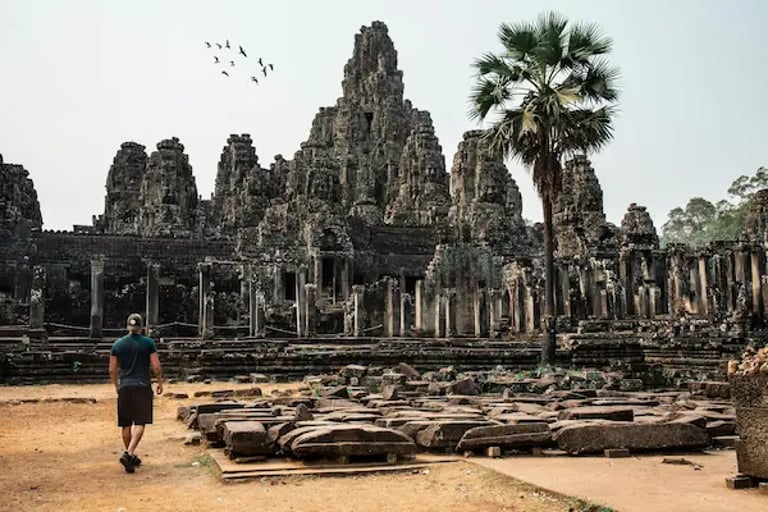
After the perfect symmetry of Angkor Wat, the logical next step leads to the ancient city of Angkor Thom and its two main marvels. Bayon is a mystical experience: its towers are sculpted with over 200 giant, serene faces, offering an enigmatic smile to every cardinal point. To appreciate it without the crowds, you must go very early (as soon as it opens) or in the late afternoon, as the low light enhances the expressions. The other must-see is Ta Prohm, the "jungle temple." Its uniqueness lies in the incredible symbiosis between stone and nature: the gigantic roots of silk-cotton and Bengal fig trees seem to strangle or support the sandstone walls. To avoid queues at the famous photo spots, cross the complex from East to West or vice-versa, as the majority of visitors follow the same pre-established path.
2.1. Bayon: The Hour of the Faces
The Bayon temple, with its 54 towers adorned with serene faces, is an architectural marvel of the ancient city of Angkor Thom. However, its small size makes it vulnerable to crowds, and contemplation is quickly spoiled once the buses arrive. Our tip is to avoid the 10:00 am to 11:30 am slot, when the crowd leaves Angkor Wat and heads here. Aim instead for 9:00 am, just after the first rush, or better yet, after 3:00 pm. At this late hour, the light fades and casts dramatic shadows that carve the expressions of the faces, lending the place an almost mystical atmosphere. If you are lucky enough to arrive after 4:00 pm, you may experience an almost private moment with these sandstone giants.
2.2. Ta Prohm: Playing with the Senses
Ta Prohm, famous for serving as a backdrop for Tomb Raider, is the place where human genius yields to the force of nature. The temple is often crowded between 10:00 am and 2:00 pm, as it is part of the classic circuit. To avoid human traffic jams and queues for photos in front of the "star root," we advise focusing on the less famous structures located away from the main paths. The vegetation has also reclaimed its rights on the secondary walls, offering scenes just as poignant, but in absolute calm. Do not hesitate to strike up a conversation with the Khmer guardians (the Apsaras of security): they often know discreet corners and unique perspectives, far from the crowd.
2.3. Strategic Gate Avoidance
Angkor Thom is an immense fortified city, not just the Bayon. Its main entrance, the famous South Gate with its bridge of demons and gods, is systematically jammed with cars and buses. For a quieter and more "explorer" approach, ask your tuk-tuk driver to use the Victory Gate or, if you are coming from the South, another gate in the Khan area. These alternative accesses allow you to enter the city via picturesque forest paths, giving you a much more immersive perspective of the ancient capital, even before arriving at the heart of the Bayon.
3. Logistics and Temple Strategy: Duration, Tuk-tuk, and Budget
3.1. How Many Days to Allocate to the Visit?
The Angkor complex is vast, covering nearly 400 km². Trying to do everything in a single day guarantees extreme fatigue and a superficial immersion. The most cost-effective and advisable entrance pass is undoubtedly the 3-Day Pass (currently 62 USD). It offers the necessary flexibility to adhere to the golden rule of the informed traveler: alternate an intense morning of temples with an afternoon of rest or exploration in Siem Reap. We recommend not chaining the visit days: do Days 1, 3, and 5, for example, to allow time between explorations for museums, markets, or simply to rest at the guesthouse. This allows you to absorb the richness of the sites without burning out.
3.2. Tuk-tuk: Mastering the Budget and Negotiation
The tuk-tuk is your best ally for exploring the site. The price must be negotiated with your driver. Expect to pay between 15 USD (Small Circuit) and 20 USD (Grand Circuit) for a full day (up to 8:00 am-5:00 pm), not counting the supplement for the sunrise (around 5 USD). Do not settle for the first price. Set the fare before leaving, clearly indicate the temples you wish to visit (it is crucial to have your own itinerary), and do not hesitate to ask for a driver who speaks a little English to facilitate exchanges. Tipping (a few dollars) is customary if the service was impeccable and punctual.
3.3. The "Asia On The Way" Favorite: Beng Mealea (Off Circuit)
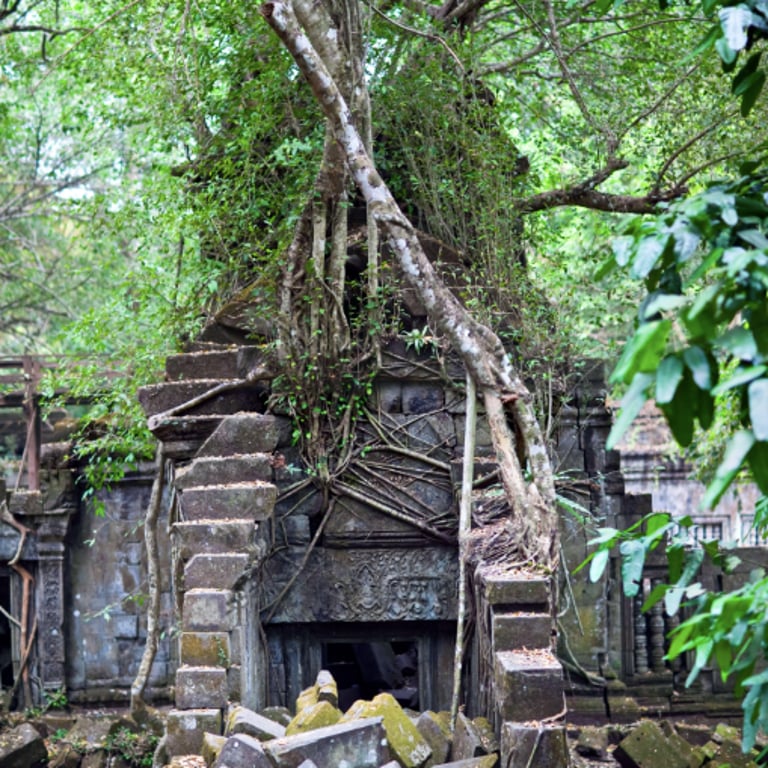
For those who truly want to get away from the flows and recapture the spirit of 19th-century explorers, Beng Mealea is our off-the-beaten-path temple par excellence. Located about 40 km east of the main circuit, it requires a supplement (and a higher price for the tuk-tuk or a taxi, as the road is longer). Unlike Ta Prohm, Beng Mealea has only been partially restored. It is left at the mercy of nature, with scattered stone blocks in the vegetation and collapsed walls. It is the ideal place to feel the apex of the Empire before its fall and to take unique photos, far from the chaos. The exploration there is adventurous and often solitary.
4. The Forgotten Jewels: The Calm of Off-Circuit Temples
For travelers seeking serenity and a more intimate connection with history, it is crucial to include sites that rarely appear on postcards, but which offer an incomparable atmosphere. These temples are the true key to getting off the beaten path and appreciating the silence of the ruins. Their remoteness, or simply the fact that they are not part of the classic circuits (Small and Grand Circuits), guarantees an often solitary experience, far from the hordes of tourists. These places, often more modest, are no less rich in detailed sculptures and attest to the extent of the Khmer Empire.
4.1. Sunset Away from the Crowds (Phnom Bakheng)
The summit of Phnom Bakheng is the favorite spot for sunset over Angkor, but the climb is limited, and you must get there hours in advance. Our advice is to prefer the Pre Rup temple, a more distant temple-mountain, whose red sandstone color ignites beautifully under the last light of day. Or, the smaller Ta Som temple, whose East Gopura (gate) is overrun by roots, offering a spectacular and poignant photo. These temples are much more accessible and less subject to access restrictions, ensuring a contemplative end to the day.
4.2. The Unknown Temples of the Small Loop (Banteay Srei)
For a truly tranquil day, dedicate it to the Banteay Srei temple, the "Temple of Women," located about 35 km from Siem Reap. Although it requires a longer journey (about 1 hour by tuk-tuk), this site is famous for the exceptional finesse of its sculptures on pink sandstone, which are the most delicate in all of Angkor. Being off-circuit and often visited in half a day, it is rarely crowded. Take the opportunity to go there after 2:00 pm and follow up with the Preah Khan temple, a massive monastic enclosure offering a beautiful symbiosis between stone and vegetation, often less congested than Ta Prohm.
4.3. The Right Time to Visit the Groups (The Influence of Seasons)
The crowd avoidance strategy must also take climate into account. During the rainy season, the temples are less frequented, the vegetation is greener, and the light is softer. However, the summer period coincides with Asian holidays and the peak of crowds. If you are traveling during the dry season (high season), plan your most important visits (Angkor Wat, Bayon) midweek rather than on the weekend, and always very early in the morning to enjoy the coolness and calm. This is the secret to appreciating the Apsaras (celestial dancers) carved in stone without the hustle and bustle.
5. Siem Reap: The Gateway to Angkor and the Transition
The archaeological zone, with its grandeur and logistical challenges, is only half the experience. The other half lies in the vibrant city of Siem Reap, which serves as the gateway and base camp for all your explorations. After spending three days amidst the Khmer temples and lush vegetation, it is crucial to reconnect with current Cambodian life. Siem Reap offers much more than just hotels and restaurants. You will find essential museums to complete your understanding of the Empire's apex (such as the Angkor National Museum), lively night markets, and above all, the opportunity to see the Apsaras dance on stage. Take the time to rest there, plan your transport south, and soak up the energy of this growing city.
5.1. Life After the Temples
Siem Reap is the perfect counterpoint to the austerity of the ruins. After a day spent in the dust and heat of the sandstone, nothing is more pleasant than strolling through the alleys around Pub Street or the night market. This is the ideal time to discover the first pleasures of local gastronomy, such as the famous Fish Amok or Lok Lak, and ensure a good night's sleep in a comfortable guesthouse. Also consider visiting the floating villages on Tonle Sap Lake for a unique perspective on Cambodian aquatic life.
5.2. Preparing for the Great South (Logistics)
Siem Reap is the starting point for your future adventures. Whether you choose to take a local bus, a shared taxi, or a domestic flight, this is where your next step toward the Capital of Cambodia is prepared. The transition to Phnom Penh is a jump in time, moving from ancient glory to recent memory. Book your tickets carefully, as the journey south is long and sometimes challenging. It is a journey that will take you not only through the country's geography but also through its history, from imperial splendor to the contemporary era.
5.3. The Duty of Remembrance: Transition to Part 3
If Angkor showed you the grandeur of which Man is capable, Phnom Penh, our next destination (Part 3), will show you the opposite. We will leave the mysterious enigmatic smiles of the Bayon towers to address the scars of the genocide and the resilience of the capital. This transition is difficult but essential. It allows for a true understanding of the Khmer people and an appreciation of the strength of the present in light of the past.
🌟 The Khmer Life Lesson: Our Conclusion
At the end of this Cambodia Itinerary in 5 Parts, the traveler you are is no longer the same. We left the timeless majesty of the Khmer temples of Angkor, where the apex of civilization dazzled us. We embraced the poignant memory of Phnom Penh, acknowledging the strength and resilience that allowed the nation to overcome the period of the genocide. And we found calm on the beaches of Koh Rong and the rice fields of Kampot, savoring the sweetness of slow travel.
Cambodia is, in essence, a country of sublime contrasts. It is the finesse of Hindu sculptures and the welcoming simplicity of the Buddhist pagoda. It is the frantic noise of the tuk-tuks and the silence of the pepper fields. But above all, it is the embodiment of a simple truth: life goes on.
This land is not just a passing destination; it is a true life lesson. The enigmatic smile of the Cambodian people is the most precious treasure you will bring back. It symbolizes a rare hospitality and an ability to look forward, despite everything.
We encourage you to adopt this philosophy of exploration: travel responsibly, venture off the beaten path to places like Beng Mealea, and prioritize sincere exchanges. Vietnam Cambodia or Laos Cambodia are merely geographical circuits; the heart of the tailor-made trip lies in the immersion you choose to put into it.
May your memories be as rich as the scent of Amok, and may your return be filled with the inspiration drawn from Khmer resilience.
❓ FAQ: Key Answers for Your Khmer Immersion
Q1. What is the historical importance of Angkor Wat and the Khmer Kingdom?
The Temple of Angkor (Angkor Wat) is the jewel of the Khmer Kingdom, a priceless UNESCO World Heritage site. It was built mainly between the 9th and 12th century, marking the apex of the Khmer civilization. The visit to the temples allows you to discover these spectacular vestiges, which are the largest religious monuments in the world.
Q2. How should I organize my Visit to the Temples of Angkor to avoid the tourist hordes?
For a successful trip to Cambodia, plan a Cambodia Circuit of several days to see several temples. To avoid the tourist horde around the major sites, focus on the temple tour during off-peak hours. Renting a scooter (if allowed) or a tuk-tuk to access the distant small temples is the best tip for traveling in Cambodia and enjoying the quiet.
Q3. What role do Buddhism and Monks play in Cambodian culture?
Buddhism is the main religion and profoundly influences the life of the Cambodians. You will see many monks in the pagodas, who embody the local Buddhist culture. In Phnom Penh, the visit to the Royal Palace offers an insight into royal spirituality, often adorned with sculpted elephant motifs.
Q4. Cambodia in Southeast Asia: Can one ignore the Khmer Rouge period?
No, a trip to Cambodia cannot be undertaken without addressing recent history. If the World Heritage is crucial, the Khmer Rouge period is an essential chapter for understanding the resilience of Cambodians today and the spirit of modern Indochina in Southeast Asia (or South Asia).
Q5. Is it easy to combine Cambodia with Thailand, and what about local villages?
Yes, it is easy to organize trips to Cambodia by combining Thailand (with a stopover in Bangkok, for example) or Vietnam. Traveling in Cambodia will also lead you to rural villages built on stilts, notably around Tonle Sap Lake, offering a striking contrast between the grandeur of the vestiges and the simplicity of local life.


🏛️ Part 2: The Majesty of History (Siem Reap and Angkor)
The Hook and the Start of the Journey: Cambodia, Much More Than a Destination.
The Majesty of History: Angkor Wat, How to Avoid the Crowds.
The Beating Heart and the Memory: Phnom Penh, Between Past and Urban Renaissance.
The Gentle Escape: Slow Travel in Kampot and Kep (Pepper, Beaches, and Rice Fields).
Culture, Cuisine, and Conclusion: The True Taste of Cambodia and Responsible Tourism
🏛️ Part 2: The Majesty of History (Siem Reap and Angkor)


Travel
Asia Blog – Practical tips about Vietnam, Thailand, South Korea, Cambodia... visas, eSIMs, banking, travel budget, and more.
© 2025. All rights reserved.